The History of the Melbourne Cup

Every year Australia and Victoria in particular, comes to a standstill on the first Tuesday in November as the nation focuses on the Melbourne Cup, the country’s largest thoroughbred horse race. The race was first run in 1861, meaning the 2011 event will be the 151st.

Originally a two mile race, the distance dropped by 18 metres to 3200 in 1972 as the country changed from imperial to metric measurements. The first race saw 17 jockeys compete for the prize pot of 710 gold sovereigns and a gold watch. The winner for the 2010 race walked away with $6 million.

The prize isn’t the only thing to have grown hugely over the years. The original race was watched by around 4000 spectators, while more than 110,000 were in attendance for the 2010 race, with many booking cheap flights from across the country and from overseas.

The Melbourne Cup made its debut on a Tuesday in 1876 and has remained on that day ever since. That year the race was won by Briseis, a filly that won the VRC Derby, the Melbourne Cup and the VRC Oaks within six days, all while being jockeyed by a 13-year-old boy. In 1877 the Melbourne Cup was first officially recognised as a public holiday.

would you think this is a horse racing? not really this is just a festival parade.

More than anything, the Melbourne Cup is famous for making a hero out of Phar Lap. The horse won the Melbourne Cup in 1930, as well as two Cox Plates and 19 other races across Australia. Phar Lap also won the Agua Caliente in Mexico, setting a record for the course before falling victim to a mysterious illness. The remains of the triumphant horse are on display in three museums: his hide in Melbourne, his skeleton in Wellington and his heart in Canberra.

The Aussie raised, New Zealand born horse is one of the most famous to run in the Melbourne Cup and until recently only locally trained horses were allowed to enter. This changed in the last decade, although few foreign trained horses cope well with the track conditions at Melbourne’s Flemington Racecourse.

Although Phar Lap wasn’t the most successful horse to enter the Melbourne Cup, he is the best known. That honour falls to Makybe Diva, the first horse to win the cup three times, who won the race in 2003, 2004 and 2005.

The 2011 Melbourne Cup is due to take place on 1 November and with cheap flights and tickets on sale now, this year’s cup is likely to be bigger than any before.


Remembering A Trip In Dresden, Germany

Life is so busy the past days. Even I am jobless, sometimes 24 hours is still not enough for me. I know how to manage my time but due to a lot of things to do both online and offline, sometimes a day is still not enough. I am just happy that I can still find time to meet with friends or spend some short trips when I can.

One of the beautiful cities I visited in Germany is Dresden, the capital city of the Free State of Saxony. One of the famous sights we visited was the Frauenkirche (Church of Our Lady). Here are some of the photographs I took during our visit.

the beautiful dome of Frauenkirche during our visit last May 2011.

The Dresden Frauenkirche, a few years after its reconsecration.

During Second World War

Dresden in the 20th century was a leading European centre of art, classical music, culture and science until its complete destruction on 13 February 1945. Being the capital of the German state of Saxony, Dresden had not only garrisons but a whole military borough, the Albertstadt. This military complex, named after Saxon King Albert, was never targeted in the bombing of Dresden. (wikipedia)

note: this is a scheduled post. I am away for a short trip..be backed very soon!


I Love German Pastries

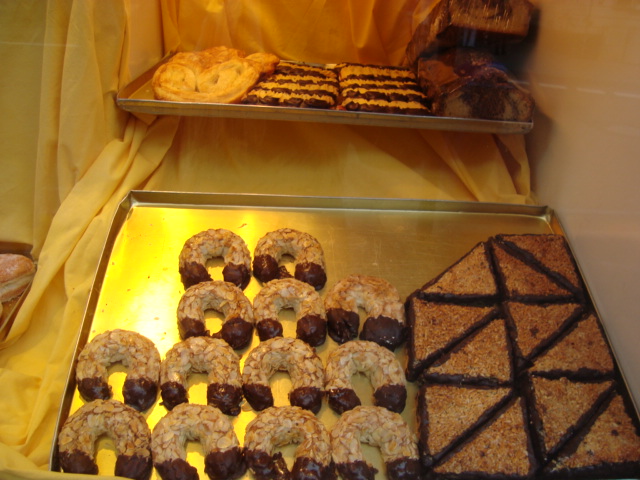
This is one of the things I love in Germany. The pastries you can buy in the bakery taste so yummy and it is not very sweet compared to the American ones. For this reason, I am quite interested in learning one of this so-called Pastry/Baker Chef Jobs here in Germany. As far as I know, one needs to have an Ausbildung for three years to be a baker in Germany. It is like a practicum and at the same time, you are also attending a class. This job is quite interesting since it is also related to gastronomy.

Don’t miss to try the good-tasting German pastries when you visit Germany. I always love it!


Back From A Short Vacation

I was backed last night with a friend from a short vacation from Austria and Hungary. It was a 5-days trip and it was truly worth it. We visited some towns and cities from these two countries. We were also on the border of Slovakia during our cruise in Esztergom going to Visegrad.

Visiting the capital city of Austria even just for a short time was also a nice experience especially after visiting St. Stephen’s Cathedral, one of Vienna’s famous sights. We also had the chance to see the Hundertwasser Haus. It was my second visit to this city and I am happy to go inside St. Stephen’s Cathedral this time. I had a special prayer and request there. Thanks God it was granted.

The highlight of the trip was our visit to Budapest, the capital city of Hungary. We also witnessed the fireworks in the bank of the Danube River that runs along this city. August 20 is Hungary’s national holiday due to its celebration of St. Stephen’s Day or Foundation of State.

I also loved the two cruises that we had. More updates coming soon about this trip in my other travel blogs.

the inside of St. Stephen’s Cathedral in Vienna, Austria. More images and updates to come in my other travel blogs soon!

Travel Euroasia

Europe Travel Pad

See The World


See You Soon Budapest, Hungary

Another trip with a friend Jean to Budapest is coming very soon. Two more nights and we will be leaving for a 5-day trip to this city and other neighboring towns of Budapest. We will also have a short stop-over in Vienna. Some other places to be visited include Esztergom, Visegrad and Plattensee, called as Lake Balaton in English.

More travel updates after our trip!

Budapest during winter time.

I was browsing in internet trying to find out the monetary unit of Hungary. Thanks to Wikitravel and xe.com for these infos below.

1.00 EUR = 269.839 HUF

Euro Hungarian Forint

1 EUR = 269.839 HUF 1 HUF = 0.00370592 EUR

1.00 USD = 187.351 HUF

US Dollar Hungarian Forint

1 USD = 187.351 HUF 1 HUF = 0.00533757 USD

Money:

Currently used coins: 5 HUF, 10 HUF, 20 HUF, 50 HUF, 100 HUF, 200 HUF

Currently used banknotes: 500 HUF, 1,000 HUF, 2,000 HUF, 5,000 HUF, 10,000 HUF, 20,000 HUF

Be sure when receiving change that all 1,000 HUF notes contain a vertical silver strip. Older notes without the strip are no longer valid. 200 HUF banknotes are also no longer valid, look out for these too!

Also, when receiving change from a taxi journey, make sure that the money is actually Hungarian. Some taxi drivers have been known to give unsuspecting passengers obsolete Romanian banknotes (lei).

Important phone numbers:

Police 107 Fire:105


Resources

Hi dear friends and visitors!! thanks for visiting me here!! Have a great and blessed day!!


WANT TO EXCHANGE LINK WITH ME? READ HERE FIRST

Extras

All photographs used on this site, including thumbnails, are the Author's property and are ©copyright. Please do not use our photos without our permission. If you wish to use one of our photos on your personal website or blog, please send us the link to the page where it is being used and the photo must be linked back to this site. We hope that you respect the Authors' request. Thank you for your respect and understanding!

Copyright © 2013 EuroAngel Graffiti | All Rights Reserved

Blog Design by RubyBenz